Hey friends, it’s that Blogference time of year again. What other conference offers so much value with no cost, bad coffee or jet lag? Drop by this week to expose yourself to fresh ideas by a variety of Christian thinkers. Topics include: Evangelistic Engagement, Moms/Women in Ministry, Books, Social Media, Leadership Development and more. Engage by commenting on a few posts or challenging the author’s viewpoint. Here is my post:
 What Would Jethro See in Me?
When I think about leadership capacity I can’t help but turn to the story of Jethro counseling Moses on how to avoid burnout in Exodus 18. You know the plot. Moses had become the de facto decision-maker for two million people and it just wasn’t working. “What you are doing is not good,” offered Jethro, “you will wear yourselves out.”
Usually when I hear this passage taught the focus rests on Moses reducing the pain of leadership by increasing his own capacity, delegating wisely, and empowering others to lead. This is true. Anyone who is serious about spiritual leadership must master these crucial lessons. But there is another angle of that is frequently overlooked: the capacity, or readiness, of the followers to whom Moses is entrusting leadership.
A closer look reveals three key criteria that Jethro had in mind for the next generation of leaders. The developmental question I would want to ask myself, as a follower, is: Would I have been chosen according to these criteria? If not, where do I need to grow? It helps me to break down Jethro’s advice in Exodus 18:21-22 like this:
1. Look at the Hands. “Moreover, look for able men from all the people…” These new leaders had to have a certain level of competence in living life wisely. This is about skills. If someone were looking for a capable person to perform a certain task, would my name come to mind? What skills must I acquire or strengthen in order to both perform my current role well and prepare me for future changes?
2. Check the Heart. “…men who fear God, who are trustworthy and hate a bribe…” Each person had to have a heart that clearly pursued God and his ways. This is about character. Do other people know what I love, fear and hate? Can I be trusted to make and keep commitments, both small and large? Character growth is tricky. It’s not like we can just put some good ideas down on a Personal Development Plan and start checking them off the list. God’s economy doesn’t work that way; it takes time. Also, sometimes I can’t even see my most needed areas of growth because I am blind to them; I need others to help me by speaking into my life. Rather than wait for an annual 360 review, I often ask teammates to give me informal feedback (and keep my heart open to their counsel).
Capacity in character grows naturally as we abide in Christ, walk in the Spirit and bear his fruit. That’s him working, not us. Paul offers several ways that we participate in growing our character: by transforming our mind (Romans 12:1-2), by allowing ourselves to be influenced by other godly people (1 Timothy 4:12), and by embracing suffering (“we rejoice in our sufferings, knowing that suffering produces endurance, and endurance produces character” Romans 5:3).
3. Examine the Head. “…and place such men over the people as chiefs of thousands, of hundreds, of fifties, and of tens. And let them judge the people at all times.” This is about perspective and discernment. Am I ready to lead ten on a team? How about 25 on a project? How about providing spiritual and strategic leadership to several teams in multiple locations across time zones and cultures? You may not currently aspire to that level of leadership, but God is always using our current responsibilities to prepare us for another future role. Movements requires people – leaders – who can rise above the clattering demands of the present and gain a longer-term perspective from the Lord. (I recently blogged about how I am learning to do this here.)
Finally, the relative importance of these different capacities shifts depending on what level of leadership is required (see the chart below). At the grassroots technical skills tend to be most crucial. We ask questions such as: Can she share her faith? Can he emcee a meeting well? How well can she keep a small group together?
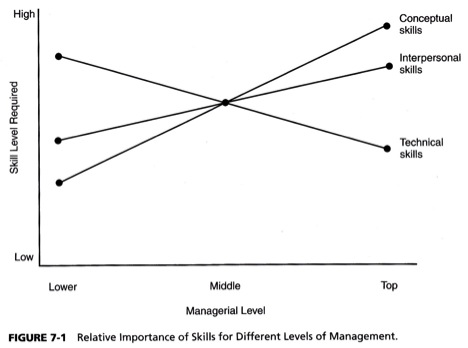
As one moves to higher levels of leadership, interpersonal and conceptual skills take on greater weight, while the need for technical skills actually diminishes. Different questions surface, such as: Is she worth following? Can he partner and share power with others? Do I trust her perspective and judgment? In choosing that strategy, is he honoring Christ and really looking out for the long-term interests of our institution? Is he lording his position over others or using his authority to serve the community and the mission? These are critical qualities for those who will lead us into the future.
What would Jethro see in you?
(Figure from Leadership in Organizations, 7th edition by Gary Yukl, Prentice Hall, 2010.)