“Did I hear you took six full weeks off? “What did you DO with all that time?”
These are the first questions I received from friends and co-workers upon my return to work following a six-week sabbatical.
What did I do? Nothing exotic, and nothing dealing with my regular work or teams.
This is my third sabbatical since 2010. I am blessed to work for an organization that values personal renewal, offering its staff a full four week sabbatical every four years served. Many senior colleagues confess that they have never taken a sabbatical, usually because they just can’t find the time. When I hear those words coming out of my own mouth, I realize that I am placing too much importance on myself, or my role, or my work. Sabbath, and sabbatical, are tools God provides to starve my ego and feed my soul.
Since I had over-planned my first two sabbaticals, I endeavored this time to answer one question, the most important question Jesus asked: How can I more deeply love the Lord my God with all my heart, soul, mind and strength?
This was all about my heart and soul. For six weeks I set aside everything related to my regular work: no email, no meetings, no phone calls, no airplanes, no texts with teammates, no strategizing or problem-solving, no conversations about work (not even with my wife who works in the same organization). I decided I would go against my type-A nature and be completely unproductive: no major house projects, no writing, no nothing.
Why did I erect such a big moat around my life? Simply because I was feeling really, really tired. Soul tired. “When we stop caring about the things we care about — that’s a signal we’re too busy. Busyness kills the heart,” writes Mark Buchanan in The Rest of God: Restoring Your Soul by Restoring Sabbath. After a few days of reflection, I discovered three main pressure points that were causing my fatigue:
-
Cognitive overload in keeping up with the rapidly changing field of digital strategy for the past four years
-
Constant vigilance in leading massive organizational change
-
Physical fatigue due to frequent international travel and the onset of asthma
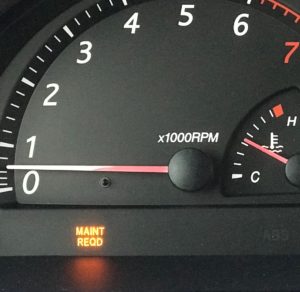
Maintenance Required
The week before my sabbatical began I was on way home from the airport from my final trip. I felt like I was limping across the finish line. My heart was apathetic toward people’s real needs, and I knew I could not endure another meeting, whiteboard session, or analytics report – no matter how encouraging they might be. The pace, the calendar, and my lungs conspired to suffocate me. I needed air. Time to breathe. Time to live. Space to delight in people and their endeavors.
Driving home that evening, the “maintenance required” light appeared on my the dashboard of my 14-year old Toyota Camry. This light became my metaphor for six weeks. Like a trusted car, I needed maintenance. Like an endurance athlete, I needed a season of rest and recovery after an extended time of intense physical and mental demands. Like a farmer’s fields, I needed a season of fallowness to follow many months of productive fruitfulness. The need for regular maintenance is not an admission of weakness or failure.
During this season of intentional non-productivity I discovered a few things about myself. For the first week I fought the compulsion to reach out and be available to people by offering a text asking how an event went, or offering to pray for someone going through a hard time. “Just one little text,” the voice inside my head whispered. I pushed the smartphone away. They did not need me to do that. God assured me that he can take care of them. The temptation and persistence of my inner compulsions surprised me.
What did I do?
First, I added an hour each day of sleep. I lingered in bed in the morning. I took afternoon naps. You would be surprised at how much extra energy and mental positivity comes from that one single choice.
I took long walks in my neighborhood. I noticed new birds (like the male cardinal on the sycamore tree out back). I took three weeks to read through a 500-page scholarly work from a different theological perspective, cross-checking each biblical reference, inviting God to change my previous convictions. I ruminated on loving God with all my heart. All my soul. All my mind. All my strength. I listened to John Bunyan’s classic “Pilgrim’s Progress” and imagined myself on that journey of faith.
I paid attention to thoughts and prompts from the Spirit of God.
My weekly cycling mileage doubled during those six weeks, which also contributed to losing a few pounds and desiring to eat clean, without any emphasis on dieting.
During the final week I allowed myself to begin praying for teammates and thinking about our organization’s next strategic moves. The five weeks away from these issues allowed freshness and energy and perspective-taking.
You may not be in a position to take a lengthy sabbatical right now. That’s ok. That time is available to any follower of Jesus in the form of a weekly sabbath. Fifty-two days each year (not counting holidays and vacation time) await you. That is how much God loves us – he offers, and even commands us, to intentionally be unproductive one day each week. It is for our good, and for His glory, that we regularly set aside time to be completely unproductive.
If you haven’t yet learned how to do a weekly sabbath, I would not recommend you attempt a longer sabbatical. Don’t attempt a marathon if you can’t run a 5K. You’ll drive yourself crazy and struggle with the silence. A day a week is all you need to set you on the path to starving your ego and feeding your soul.