Author: Ken

  • The One Thing Leaders Want

    Leaders want dialog.

    You want the ability to discuss, debate, shape and influence a decision before it is made.

    The people you lead — or your teenage daughter, or the committee members at church, or the division heads of your organization — want the same thing with you.

    Honest, open dialog facilitates shared leadership. Leaders want to share leadership.

    This fascinated me, as when our organization restructured recently, one of the five principles guiding our efforts was “shared leadership.” Many leaders initially resisted this, claiming that the essence of leadership—at least in their culture—was having someone in charge to make the final decisions. Yet people don’t want to be led that way. They want to voice their opinions. They want to help shape overall direction. They long for the dynamic interaction among leader-followers that characterizes high performance teams. They want to be engaged in issues and decisions that they will ultimately own. They long to share leadership.

    Leaders want dialog.

    Read more on this topic in my book CLOSE: Leading Well Across Distance and Cultures.
     

  • Seek Rhythm, Not Balance

    The longer I live and the more places I visit, the more I appreciate changes in season. This week the weather in Orlando, Florida, where I live, shifted from dark-soggy-winter-chill to warm-bright-spring. The change naturally invites me to be outdoors more, leave work a bit early, and enjoy some long bike rides.

    My motivation wasn’t forced. It felt like a natural rhythm of grace.

    As a leader, the longer you lead, the more you have to pay attention to the natural seasons of leadership. Introducing another new change initiative when your team has been pushing hard to meet deadlines or deliver a fantastic event can feel like you’re pushing a huge boulder up a mountain. That boulder may be a combination of physical fatigue, emotional resistance, or simply too much at too fast a pace for too long.

    For years I fell under the false assumption that I could live a balanced life. Time management books promised me it was possible. Balance assumes I can keep all the plates spinning. I’m learning that seasonal rhythms – allowing some plates to fall and just remain on the ground – is actually the way God designed people and nature to work. When managed well, it feels more natural.

    For the past two months I lacked motivation to post on my blog. I would begin a new post and stare at the screen but nothing would come. I’d pray and feel guilty, but the well was dry. I reflected on my lack of motivation and realized that I had just come off a heavy season of writing, editing, and publishing my book CLOSE, an intense season of travel and meetings, and 10 days of fun holiday vacation with my family. Like an athlete, I simply needed some off-season time to allow my writing muscles to fully recover. Now I’m back.

    The wise teacher of Ecclesiastes 3 instructs us that “for everything there is a season, and a time for every matter under heaven… a time to plant and a time to pluck…a time to break down, and time to build up… a time to weep and a time to laugh….”

    A wise leader knows what time it is. What season are you in?

  • The Inevitability of Shared Leadership

    In today’s new rules of work, getting meaningful work done is no longer place-centric or position-centric, but people-centric.

    The use of social media, not just for play, but as a primary platform for work-related interaction, has accelerated the shift from top-down hierarchies to flatter networks. Every organization has informal networks — back channels  — that allow people to get what they need, when they need it. Mobile devices and social media have turned these obscure jungle trails into relational super highways.

    This shift affects how you, as a leader, must perceive your role as an influencer.

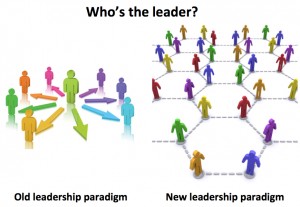
    Old and New Lship Paradigm

    Leadership is influence. Most of us were trained in a more traditional leadership model emphasizing the leader’s role as direction setter, change agent, spokesperson, problem-solver, strategy-formulator, vision caster, and aligner. Taken at face value, the net result of these roles and responsibilities will produce a leadership bench full of one-way communicators who are always selling and not necessarily listening.

    In the new leadership paradigm, each of us operates as a node in a network. We consume information, advice, counsel, and make decisions based on multiple interactions with other people, not just our boss. Who’s the leader? The one who can offer relevant help, initiate needed change, and model the way ahead. Shared leadership becomes organic in this environment; it is inevitable.

    Think about this from your own point of view. Where do you go for advice? I find myself searching Google, Twitter, or asking friends far more than I text or ring my boss.

    One implication for me as a team leader is that I must be clearer than ever with my team about who our primary audience is and what our desired outcomes are. When our mission is clear, informal networks strengthen our ability to get the work done rather than threaten my authority as a team leader. It’s time to embrace the inevitability of shared leadership.

    How are you experiencing the inevitability of shared leadership?