Author: Ken

  • Reading Week

    “Leaders are readers, and readers are leaders.”
    – Prof. Howard Hendricks

    I can still hear Prof’s exhortation ringing in my ears from a class I took from him 25 years ago. Broad reading is crucial to expand one’s leadership horizons. Others agree. Oswald Sanders devotes an entire chapter to “The Leader and Reading” in his classic Spiritual Leadership.

    It has been my practice for about the past ten years to devote a week every six months to some serious reading. Of course, like you, I’m reading all the time. Reading week is different, though. It’s a week devoid of meetings, appointments, or any pressure to respond to emails. This mini-sabbatical gives me an opportunities to prayerfully pursue new ideas. This type of mental and spiritual renewal is crucial for successful leadership, otherwise I can easily get bogged down in groupthink or “well, we’ve always approached it such and such a way.”
    Just to be clear, I never feel compelled to read every page in a book. Most printed books published today are designed to sell copy and need 200-300 pages to justify the publisher’s cost. The author’s core idea can usually be found in the Preface and Chapter 1, with some really good support sprinkled through the remaining chapters. Much of the rest is filler. If a brief scan of the first 25% of the book doesn’t reward my time or bring new ideas, the book will probably go into the trash can or deleted from my iPad. Life’s too short to read average books.

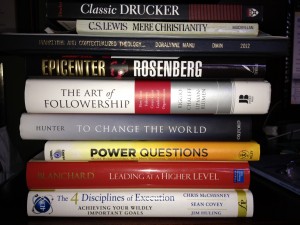
    Here’s the stack I’ll be working through this week, Lord willing, for a few hours each day. Some are new to me, others will be reviewed for key ideas that seem relevant to the next season of ministry.

    I’ll read quickly, lingering where I feel like it. I’ll highlight, underline, annotate, and dog-ear like crazy. I won’t feel guilty if I don’t make it through the whole stack. This week is for me and my own development. Above all, I’ll keep the words of the Preacher in mind: “But beyond this, my son, be warned: the writing of many books is endless, and excessive devotion to books is wearying to the body” (Ecclesiastes 12:12).

    How do you approach reading for your personal development?


  • Innovate or Die Trying: 3 Links

    “You win by trying. And failing. Test, try, fail, measure, evolve, repeat, persist, …”
    Seth Godin, American author and Marketing Expert

    What does it mean to innovate? My Mac dictionary defines “innovate” this way:

    innovate |ˈinəˌvāt| verb

    1. make changes in something established, esp. by introducing new methods, ideas, or products: the company’s failure to diversify and innovate competitively.

    2. introduce (something new, esp. a product): innovating new products, developing existing ones.

    Innovation is making changes or making something new. We hear a lot about innovation today. I am surprised by the number of people, blogs, and leaders urging me to innovate! Innovate!! INNOVATE!!! without giving me some clear sense of why or how to proceed.

    Here are three really good links on innovation that came through my RSS feed this week. They address both the whys and hows of innovation.

    Why Newspapers Were Doomed All Along – HBR

    Big idea: Birmingham and New Orleans will become the first significant U.S. cities (each has a metropolitan-area population of a bit more than a million) without daily newspapers — another landmark in the sickeningly fast and sure-to-continue collapse of the once money-gushing U.S. regional newspaper industry.

    Key quote: “The Internet has unbundled the various businesses that made up a metro daily newspaper, and there’s no putting them back together again.”

    The Social Network Gospel – Christianity Today

    Big idea: How interconnectivity helps us better engage the Bible.

    Key quote: “Think big, start small, fail fast; learn rapidly.” To try repeatedly is vital in engaging people with Scripture online. The digital environment welcomes raw attempts and quickly forgives trial-and-error efforts that are promptly corrected and adapted with improvements.”

    Start-ups, Skunkworks, and Your Next Big Product  – HBR

    Big idea: For large companies to create new growth opportunities they will need to redefine what innovation means within their walls. Over the last ten years, as businesses have tried to understand and pursue innovation, their organizations have been left confused of its purpose and its benefit. Much of this confusion stems from applying one term to too many contexts. Most businesses are actually pursuing two types of innovation; product innovation and process innovation.

    Key quote: “Allow small teams to iterate their ideas, to gather data and develop performance metrics, and to quickly discard less promising in favor of stronger ones. These organizations create strong networks, provide guidance, and help fledgling companies succeed where large companies currently fail; their single goal for existing is to bring ideas to the market.” 

    Why and how are you innovating?

  • My Thesis: A Paradigm for 21st Century Global Leaders

    Do you wake up every day with a calling to lead people you can’t physically see or touch?

    Do you regularly engage in team or project work with people from other cultures?

    Do you long for the hype of “leader as omnipotent hero” to give way to a more authentic model of “leader as servant?”

    If you answered yes to one or more of these questions, you may be interested in scanning through “Servant Leadership Across Distance and Cultures: A New Paradigm for 21st Century Global Leaders.” Catchy title, I know. Such is the nature of academic work. You can also find my thesis on the Downloads tab on my blog. I’d love your feedback.

    Here’s the Abstract …

    This project addresses the lack of a distance leadership paradigm to adequately prepare servant leaders who are capable of leading well across distance and cultures within Campus Crusade for Christ’s (CCC) global level of leadership.

    Research explored three aspects of leadership: servant leadership, distance leadership, and cross-cultural leadership. First, servant leadership builds on and surpasses other leadership models for global work because it seeks first to serve and develop others into mature, autonomous leaders who will, in turn, serve others. Robert Greenleaf’s test for increasing personal autonomy in servant leadership is essential in distance leadership because close supervision is impossible and counterproductive to organizational effectiveness. Second, effective distance leaders learn to overcome relational distance by using advanced communications technology to build and sustain trusting relationships with followers, partners, and other leaders. Third, effective global leaders grow in self-awareness of their own cultural bias and learn how to manage cultural diversity by studying, respecting, and dialoguing about cultural differences.

    Field interviews and group discussions with more than 80 of CCC’s global leaders highlighted personal humility and building trusting relationships as two keys to effectively leading across distance and cultures. Helps and hindrances were identified in three categories: communication-rich relationships, integrity and trustworthiness in personal character, and leadership competence in using advanced communications technology. Findings strongly supported biblical servant leadership examples of Jesus Christ and the apostle Paul, Kathleen Patterson’s servant leadership virtuous construct, and the GLOBE study of 62 societies’ culturally endorsed leadership theory (CLT).

    The researcher presents a new paradigm for 21st century global leaders.

    I welcome your feedback at [email protected].