
Author: Ken

  • It’s Still About Character

    change_aheadWe’re in the middle of the most rapid and wide-ranging organizational change process I’ve ever been a part of. One month ago we merged several different technology and digital teams into a single Global Digital Strategies entity. If the early wins are any indication, we’re in for a great future together.

    Many find this exciting. Outsiders and friends in the industry have said to me, “Finally. You should have done this months ago.” Some are feeling displaced and angry. Others quietly express concerns.


    A colleague listened to me recount some of the challenges and criticism my team and I have endured. Then he posed these unexpected questions:
    • Can my character handle the extent and scope of the ministry God wants to give me?
    • How do I deal with personal attacks?
    • What about attacks on the team?
    • How do I handle criticism from the casually uninformed?
    • What about resisters who are convinced we have made a terrible mistake and must return to Egypt?
    • Will others find me defensive, proud, and pugnacious? Or will they encounter love, patience, grace, and authentic spiritual leadership?
    Often Christian leaders fail because they have been too successful, it has gone to their head, then seeped down into their heart. Each conversation is part of the journey God wants me to experience. Some people may not get this for a year, or two years, or ever. How I respond to others is the key. I can’t control the outcomes, but with the Spirit’s power I can control my responses.

    Leadership is still about character.
  • A Leader’s Lament in Organizational Change

    Lord, I hurt for those who are hurting in our transition.
    My own heart aches.
    My mind races, anticipating – rightly or wrongly or incompletely – the losses of the sweet culture grown up on our tiny little team.

    One of many teams in a huge organization.

    You are leading us; we cannot go back.

    As we lament, Lord,
         hear our prayers,
         heal our hearts,
         comfort your people.
         Open our eyes
              to fresh possibilities.
         Steady our feet to stand on You, our Rock.
         Guard our hearts from pity and pride,
              and from fear of the unknown.
         Fill our minds with wise ideas.
         Tune our ears to listen to your Spirit,
              and to one another.
         Strengthen our hands

              for the good work You have for us.

    Protect us, protect me, from Rehoboam’s Folly.
    Give us the bold humility of Jesus.
    Not to us, O Lord, not to us,
        but to you be the glory.
  • How fast can your team pivot?

    Among the many lessons our digital strategies team keeps learning is the need to think from the outside in. Whether you call it user experience (UX), human centered design (HCD) or common sense, it’s critical to keep a user’s first experience in mind.

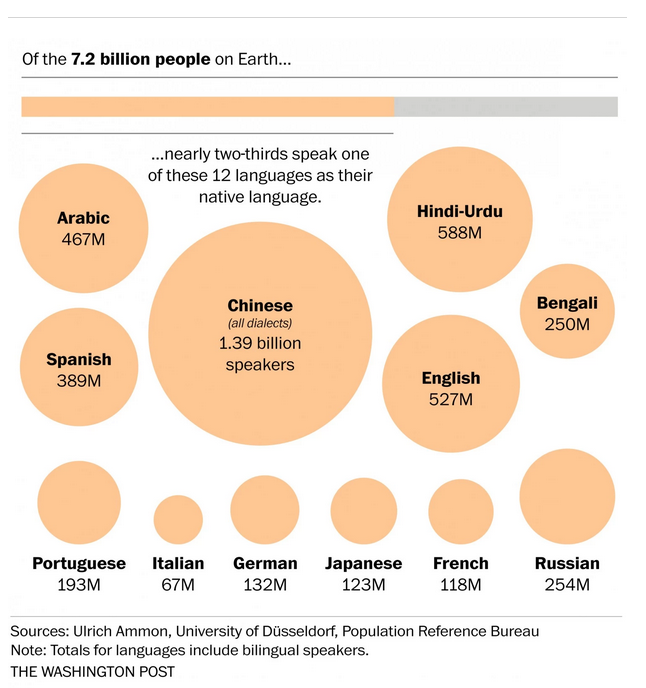
    Our team offers products that reach out globally. One of the apps we develop is GodTools, serving about 900 users each day in 36 languages and has been downloaded in 195 nations. But we didn’t start there. We began with only one language, English, and have been adding on through the help of volunteer crowd-sourced translators.

    12 most spoken native languagesRecently we realized, thanks to this article in the Washington Post, that we were missing key languages that would greatly increase the tool’s adoption. What might happen if we were to include Bengali, German, Italian and Japanese? Now that we’ve become aware of this information, we can focus our strategy on the next best opportunities with the greatest leverage. We’ll keep this in mind, not just for one product, but for all of our digital assets, social media feeds, and web offerings.

    It’s not rocket science; it’s just a simple pivot. We keep one foot firmly planted in our original plan, then pivot and plant our other foot on a more promising pathway.

    Leadership in the digital age requires an immense amount of flexibility and agility as new information surfaces. Gone are the days of five year strategic plans. We operate off a clear vision map and a set of 12 month goals broken down into small tactical sprints.

    How is your team learning to pivot?