Year: 2015

  • How fast can your team pivot?

    Among the many lessons our digital strategies team keeps learning is the need to think from the outside in. Whether you call it user experience (UX), human centered design (HCD) or common sense, it’s critical to keep a user’s first experience in mind.

    Our team offers products that reach out globally. One of the apps we develop is GodTools, serving about 900 users each day in 36 languages and has been downloaded in 195 nations. But we didn’t start there. We began with only one language, English, and have been adding on through the help of volunteer crowd-sourced translators.
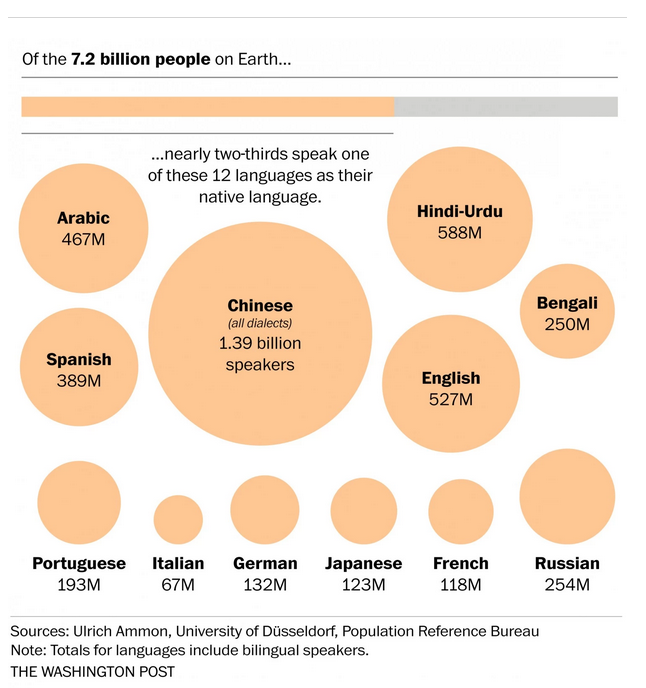
    12 most spoken native languagesRecently we realized, thanks to this article in the Washington Post, that we were missing key languages that would greatly increase the tool’s adoption. What might happen if we were to include Bengali, German, Italian and Japanese? Now that we’ve become aware of this information, we can focus our strategy on the next best opportunities with the greatest leverage. We’ll keep this in mind, not just for one product, but for all of our digital assets, social media feeds, and web offerings.

    It’s not rocket science; it’s just a simple pivot. We keep one foot firmly planted in our original plan, then pivot and plant our other foot on a more promising pathway.

    Leadership in the digital age requires an immense amount of flexibility and agility as new information surfaces. Gone are the days of five year strategic plans. We operate off a clear vision map and a set of 12 month goals broken down into small tactical sprints.

    How is your team learning to pivot?


  • How to Help Younger Leaders Grow

    One of the highlights in this season of my life is investing in younger leaders as they grow and develop. I am often asked for a conversation, book recommendations, or specific advice about “how can I increase my leadership capacity?”

    Recently my friend Keith Webb wrote a fantastic blog post on this topic. He captures some key principles in how to develop younger leaders. In particular, he highlights the critical importance of developing the leader’s heart as much as developing the more visible external skills. In Keith’s words:

    “Young leaders feel ready for big, fast and significant. Jesus took a different approach. Jesus viewed leader development as more about who the leader is rather than what he or she can do.

    Jesus focused on the internal development of the leader – going in before going out. Because who you are is how you will lead.

    What internal development is needed? Young leaders must develop:

    • their influence
    • submission to authority
    • personal integrity
    • relational abilities
    • conflict management
    • and character

    The early, small lessons learned in these areas will form the foundation on which a leader stands. Later, when the stakes are high and the pressure is great, the leader who was faithful with little will most likely succeed with much.”

    Keith also draws heavily from J. Robert Clinton’s work, The Making of a Leader, which you should consider reading if you haven’t already.

    On a personal note: I’ve known Keith for many years since we served together on a school board in Singapore. He is a gifted coach of coaches, and I have sent many of my teammates through his excellent coaching program. Keith blogs regularly at www.keithwebb.com
  • Soaked in Holiness?

    Early in my ministry years a mentor invited me to regularly read cover-to-cover through the Bible. Thirty years later I find myself grateful that I have taken his advice to heart.

    This year, in reading through the Message, I stumbled across this gem, “soaked in holiness,” in Exodus 29. Moses recounts the story of how God was forging a new nation. The raw material of this new entity came from an extended family of two million slaves who had endured four centuries of brutal oppression. This new nation required extraordinary leadership by ordinary people. God wasn’t asking the leaders to be perfect; he was requiring them to be holy. The phrase “soaked in holiness” appears when Aaron and his sons are being ordained to serve the people, and a new altar is being consecrated for seven days. “The Altar will become soaked in holiness–anyone who so much as touches the Altar will become holy.”

    Holiness does not mean perfect or prudish or self-righteous or standoffish. Holiness means set apart for special use.

    The idea of being soaked in holiness complements well the new testament’s exhortations for saints–people set apart to God–to walk in and be filled with God’s Spirit.

    Lord Jesus, would you make me, as your disciple, a man soaked in your holiness? Not a man dripping in my goodness or competence or self-righteousness. I repent of all attitudes and actions that get in the way of my life being set apart to you. Amen.

    How about you? Are you a leader soaked in holiness?