For a paycheck? To keep your job? To avoid boredom?
Or perhaps because you were eager to pursue your calling.
Because you believe that what you do today might make a difference tomorrow.
Because deep down inside you believe you can change the world.
Here is a fantastic TED presentation by Simon Sinek on how leaders inspire others to action with the power of why. Genuine movements always begin with a WHY – a cause. What’s your Why?
Yesterday I rode my Cannondale road bike 170 miles coast-to-coast across the state of Florida in 11 hours and 1 minute. It was harder and easier than I had envisioned.
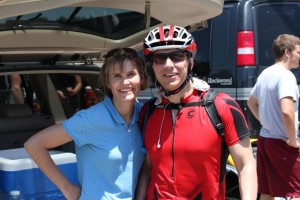
This would not have been possible (for me, anyway) without the dynamic, organic teamwork that occurs within a cycling group. It would have been unthinkable in the mid-90’s heat and 40 miles of hills without roadside encouragement and support from my wife and others. They provided water, food, fresh electrolyte-laden bottles, cold towels, and lots of smiles urging us to keep pedaling.
Executive Summary
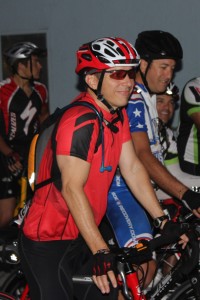
Fresh and ready
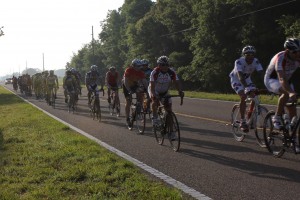
We rolled out of Cocoa Beach on the east coast at 6:30 a.m. sharp. Only 72 riders registered – 69 men and 3 women. The entire group moved at a good pace during the cool morning hours, averaging between 21-22 mph. Our first stop was at 46 miles. That’s when the faster riders broke away.
At 85 miles Todd and I were in a nice paceline with a dozen riders hitting about 20 mph. The sun was up and it was getting hot. I found myself thinking “We’re halfway done. I think I might make it.”
The peloton rolling along
At 120 miles we had lost a few to heat exhaustion. I saw one rider with an IV hooked up in the back of a van. We were still optimistic, though we were about to enter 40 miles of hills. Ouch. On some climbs we averaged 5-7 mph hitting 37 mph coasting down the backside.
At 150 miles my right thigh began to cramp and lock. Ann noticed that I wasn’t emptying my water bottles as quickly as I had been and urged me to drink more. I began opening up Endurolyte capsules and taking the salts straight on my tongue with a water chaser. “Only 20 more miles – I don’t want to quit now!” I backed off the group’s pace and went solo for awhile. I rode on. Rather than stopping to rest, I tried letting my left leg do 3/4 of the work while I did deep tissue massage on my other thigh with my right thumb. I also prayed: God of the universe who created the stars, can you prevent these muscle fibers from locking up for about one more hour?
Rest stop @ 110 miles with my supporting angel
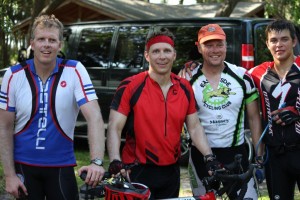
After a few miles, my good friend Todd circled back to pull me in for the final 10 miles. Zach and Bill joined up after fixing two flats and we picked up one more stray rider. The five of us rolled across the finish line on the west coast at 5:31 pm with nearly three hours to spare before sunset. Stopping felt great. So did the dip in the lagoon.
Done. Todd, me, Bill and Zach. Scratch that one off the bucket list.
Thanks are due to my Creator, Ann, Todd, Zach, Bill, the Eastside Cycling Club and the Spacecoast Freewheelers. I couldn’t have made it without your help.
Tomorrow I am attempting to ride my bicycle 170 miles (~274 km) across the state of Florida. Lord, legs and lungs willing, several hundred cyclists will begin at sunrise on the eastern Atlantic coast and finish on the western Gulf coast before sunset (see map). A huge party with lots of BBQ will lure us to complete our journey.
The farthest I’ve ever cycled in one day was 92 miles. Tomorrow is nearly twice that distance. During my last few training rides I’ve been asking myself: Will my body even be able to endure this distance and time in the saddle? What will be necessary to finish well? Here are four crucial secrets to extreme endurance that I’ve gleaned from veterans. It seems these same principles apply to many other challenging endeavors in life:
Have the right equipment. Most of us won’t be riding $5,000 all-carbon frame bikes with elite racing components. But those who finish will have good quality road bikes that are clean and well-tuned. They’ll also have the right clothing for pressure points that matter most, such as well-padded shorts, stiff shoes with cleats, comfortable gloves and good shades.
Train appropriately. Tomorrow’s ride is not a sprint, it’s a double-marathon of 10-11 hours. Finishers will need long, steady-paced effort. The training base required is one of regular 1, 2 and 3-hour rides over the past several months. Unless you’ve already developed the wind and strength in another sport, it’s unlikely you can just wake up and decide to do this. Intentional, specific preparation will be key.
Replenish along the way. Carbo-loading the night before is a myth. That energy might last an hour or two. We’ll be burning about 800 calories per hour and sweating out several pounds of fluids in 90 degree (32 C) weather. Muscles will be screaming for glycogen to fuel their efforts. Though I won’t need to replace my energy calorie-for-calorie, I will need to be eating and drinking constantly if I don’t want to bonk. I’ll be consuming lots of complex carbs, protein, and electrolytes to ensure my engine keeps running smoothly.
Rely on others. It’s common knowledge that geese can fly about 70% farther in V-formation than by going it alone. The same is true for cycling with a group of people who share leadership in a paceline. There’s no way I’d be able to ride that distance without drafting behind others. Etiquette will also require that I pull my fair share of time up front, helping break the wind for the group. I’m riding with a couple of friends, and we’ll attach ourselves to various groups along the route. When my motivation flags, others’ vision will spur me to keep pedaling. My sweet wife Ann will be driving our sag wagon, toting extra food, water and gear that we may need throughout the day. It takes a village….
What challenge are you currently facing that may require different equipment, new training, continuous help along the way, or increased reliance on your network?
Cookie Consent
We use cookies to improve your experience on our site. By using our site, you consent to cookies.
Used by Google Analytics to determine which links on a page are being clicked
30 seconds
_ga_
ID used to identify users
2 years
_gid
ID used to identify users for 24 hours after last activity
24 hours
_gat
Used to monitor number of Google Analytics server requests when using Google Tag Manager
1 minute
__utma
ID used to identify users and sessions
2 years after last activity
__utmt
Used to monitor number of Google Analytics server requests
10 minutes
__utmb
Used to distinguish new sessions and visits. This cookie is set when the GA.js javascript library is loaded and there is no existing __utmb cookie. The cookie is updated every time data is sent to the Google Analytics server.
30 minutes after last activity
__utmc
Used only with old Urchin versions of Google Analytics and not with GA.js. Was used to distinguish between new sessions and visits at the end of a session.
End of session (browser)
__utmz
Contains information about the traffic source or campaign that directed user to the website. The cookie is set when the GA.js javascript is loaded and updated when data is sent to the Google Anaytics server
6 months after last activity
__utmv
Contains custom information set by the web developer via the _setCustomVar method in Google Analytics. This cookie is updated every time new data is sent to the Google Analytics server.
2 years after last activity
__utmx
Used to determine whether a user is included in an A / B or Multivariate test.
18 months
_ga
ID used to identify users
2 years
_gac_
Contains information related to marketing campaigns of the user. These are shared with Google AdWords / Google Ads when the Google Ads and Google Analytics accounts are linked together.