What are the top global trends that will influence your life, work, or ministry for the next several years?
Recently a colleague asked me that question. As I reflect on my continuous diet of news, research, and reading, here are my top 8 Global Game-changers:
Cloud computing
Biotech
Globally connected economies and markets
Wealth gap/income disparity
Mobile device as primary personal all-in-one communication/info tool
Shift from hierarchy -> networking model in every institutional form (governments, education, non-profits, Forbes 500 corporations)
Terrorism and extremism’s violence as a norm
Spiritual revival and awakening as people turn to God for answers to 1-7 above
My creativity blossoms when I see a clean whiteboard or a fresh page in my journal. At least to start something. But once the ideas get flowing and people and projects come together I have learned, over many years in leading, that mess is best.
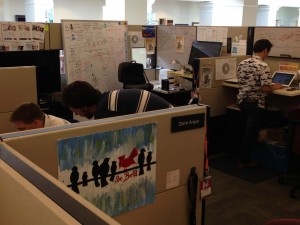
Over the past year I have been working with a team of creatives. These folks thrive amid messy desks, crazy decor, strange art, police tape, hi viz colors, unfinished meals, and the constant buzz of collaboration. Our little area in the corporate HQ doesn’t quite fit into the normal culture. A discarded oversized whiteboard maps out the next iteration of a mobile app. No Thomas Kinkade paintings here.
It’s one of the messiest places I’ve ever worked. It’s also one of the most productive. We’ve nicknamed our little corner The Oxpen.
Howard’s rattlesnake and gator headThe Oxpen
Proverbs 14:4 says: “Where there are no oxen, the manger is clean, but abundant crops come from the strength of the ox.”
Translation: You can choose clean and orderly, or you can choose messy and productive. You can’t have it both ways as a leader.
Movements of God are messy. People are messy. Leadership is messy. Leaders embrace the mess. As we lead in a 21st century world of rapid iteration, agile product development, and 7 second social media attention spans, we’ve got to create environments where the oxen can make a mess. The farmer’s goal isn’t a clean manger; it’s a well-tended highly productive field. Unless you’re running a hospital or a silicon chip factory, your goal as a leader is not a well-ordered workplace. Your goal is fruitfulness.
Don’t be afraid to step in the fertilizer and embrace the mess of the oxpen.
How digitally mature is the organization you work for?
One year ago I didn’t even understand the question, much less have any way to answer it. Over the past 12 months a number of my colleagues and I have been exploring the implications of being digitally immature in a 21st century global culture in which:
4 continents have more mobile phone subscriptions than they have people
25% of North Americans access the internet only via a mobile device
terrorists have become experts at using social media to recruit and radicalize members toward their cause
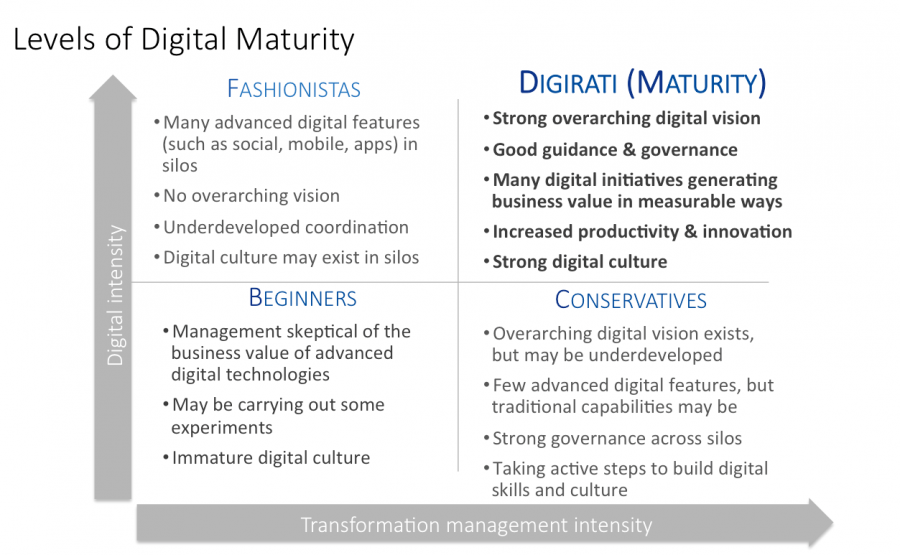
Digital maturity occurs when an organization is increasing both in digital capabilities (mobile apps, social media engagement, delightful user experiences) and transformational leadership across every nook and cranny in the organization.
Here’s a short four-minute video that explains some key concepts I’ve shared with some of our staff about digital maturity. The “10M” represents our desire to empower 10 million multiplying leaders around the world to do what God has called them to do.
http://youtu.be/UYHFj-pgAjw
Look at the chart below. Which quadrant best describes the current state of your organization, church or business?
Source: Capgemini Consulting, The Digital Advantage
Cookie Consent
We use cookies to improve your experience on our site. By using our site, you consent to cookies.
Used by Google Analytics to determine which links on a page are being clicked
30 seconds
_ga_
ID used to identify users
2 years
_gid
ID used to identify users for 24 hours after last activity
24 hours
_gat
Used to monitor number of Google Analytics server requests when using Google Tag Manager
1 minute
__utma
ID used to identify users and sessions
2 years after last activity
__utmt
Used to monitor number of Google Analytics server requests
10 minutes
__utmb
Used to distinguish new sessions and visits. This cookie is set when the GA.js javascript library is loaded and there is no existing __utmb cookie. The cookie is updated every time data is sent to the Google Analytics server.
30 minutes after last activity
__utmc
Used only with old Urchin versions of Google Analytics and not with GA.js. Was used to distinguish between new sessions and visits at the end of a session.
End of session (browser)
__utmz
Contains information about the traffic source or campaign that directed user to the website. The cookie is set when the GA.js javascript is loaded and updated when data is sent to the Google Anaytics server
6 months after last activity
__utmv
Contains custom information set by the web developer via the _setCustomVar method in Google Analytics. This cookie is updated every time new data is sent to the Google Analytics server.
2 years after last activity
__utmx
Used to determine whether a user is included in an A / B or Multivariate test.
18 months
_ga
ID used to identify users
2 years
_gac_
Contains information related to marketing campaigns of the user. These are shared with Google AdWords / Google Ads when the Google Ads and Google Analytics accounts are linked together.