Category: Teamwork

  • What Is Shared Leadership?

    Leadership is hard work. Good leadership is really hard work. Today’s dynamic, rapidly changing knowledge economy provides an ever-shifting landscape that requires multiple perspectives to navigate well.

    Exit the know-it-all, do-it-all leader.

    Enter the self-aware, in-touch connector that can share leadership by pulling people, resources and ideas together to get the job done.

    What is shared leadership? Marshall Goldsmith describes it this way in an excellent post: “Shared leadership involves maximizing all of the human resources in an organization by empowering individuals and giving them an opportunity to take leadership positions in their areas of expertise. With more complex markets increasing the demands on leadership, the job in many cases is simply too large for one individual. Sharing leadership isn’t easy, but it’s definitely possible, and in many cases, highly successful.”

    Goldsmith suggests ways to share leadership and maximize talent. Here are a few:

    • Give power away to the most qualified individuals to strengthen their capabilities.
    • Define the limits of decision-making power.
    • Cultivate a climate in which people feel free to take initiative on assignments.
    • Give qualified people discretion and autonomy over their tasks and resources and encourage them to use these tools.
    • Don’t second guess the decisions of those you have empowered to do so.

    As leaders, our job is to constantly move those people our organizations touch from strangers to acquaintances, from acquaintances to friends, and from friends to partners in our common mission. Sharing leadership usually provides the best pathway to true partnership.

    How are you learning to share leadership?
  • Trust: Three Ways to Build It

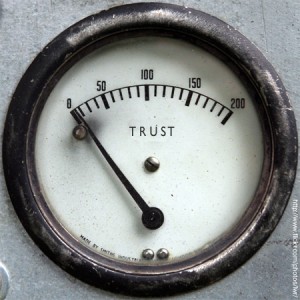
    What’s the number one quality followers look for in leaders or peers they allow to influence them?
    Trust.*

    Trust is confidence based on previous experience. Trust is the foundation that must bear the daily load of bumps and bruises in every personal and working relationship. Trust often takes months or even years to build, but can be destroyed by a single act of irresponsibility, immorality or perceived betrayal. More commonly, trust erodes over time due to lack of attentiveness and self-awareness.  Since trust is so critical, how do we build trust?

    Here are three gauges I use to monitor the balance in my trust account with others:

    1. Character. As a 7th generation Texan, I grew up in an environment where a person’s handshake was usually as good as a contract. I vividly remember a couple of times when I broke my word and had to go back to make it right. Sometimes it involved redoing shoddy work. Sometimes it involved financial restitution. There were a few embarrassing confessions and requests for forgiveness. I didn’t miss the lesson, though: Pain forges character. Can others believe what I say? Will I follow through on those things I’ve committed to? Is my “yes” a yes and my “no” a no, or will others have reason to believe that I will waver on commitments I’ve made?

    2. Competence. Work done well builds trust. When I need a plumber or a mechanic, I ask my neighbors who they would recommend (or not recommend). Perhaps you’ve got some technical expertise that’s in high demand. Maybe your EQ is off the charts and you provide the critical relational glue for a group. Maybe you’re responsible, organized, diligent, networked, or service-oriented. Whatever it is, the more you bring it to bear with consistency and humility, the more rapidly your trust account will grow. Also, unless you’re a rock star or pro athlete with a multi-million dollar contract, technical excellence coupled with arrogance usually increases resentment and undermines the trust-building process. What skills and abilities do I offer to my boss, my team, my family or the larger community? How am I developing my level of proficiency in these areas?

    3. Concern. We’ve all heard the maxim: People don’t care what you know until they know that you care. When it comes to building trust, demonstrating authentic concern is key. I quickly trust people who I perceive care about me and my stuff. Call it empathy or call it love, trust grows rapidly when each party knows the other person is looking out for their best interests. Misunderstandings and vain imaginations vaporize when I know you’ve got my back. What level of genuine concern am I expressing in this relationship?

    Action points for leading well:

    1. Do what you say you will do.

    2. Do it well.

    3. Do it with others’ best interests in mind.

    *Source: This intuitive fact can be verified by any number of sources. Two of the broadest representative surveys of managers, employees and business leaders that reveal trust (or its counterpart, honesty) as the #1 factor are Strengths-Based Leadership by Rath & Conchie and The Leadership Challenge by Kouzes & Posner.

  • My Ride Across Florida 2010

    Yesterday I rode my Cannondale road bike 170 miles coast-to-coast across the state of Florida in 11 hours and 1 minute. It was harder and easier than I had envisioned.

    This would not have been possible (for me, anyway) without the dynamic, organic teamwork that occurs within a cycling group. It would have been unthinkable in the mid-90’s heat and 40 miles of hills without roadside encouragement and support from my wife and others. They provided water, food, fresh electrolyte-laden bottles, cold towels, and lots of smiles urging us to keep pedaling.

    Executive Summary

    Fresh and ready

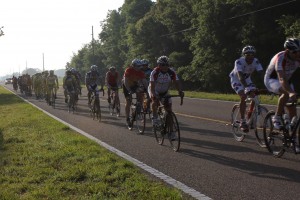
    We rolled out of Cocoa Beach on the east coast at 6:30 a.m. sharp. Only 72 riders registered – 69 men and 3 women. The entire group moved at a good pace during the cool morning hours, averaging between 21-22 mph. Our first stop was at 46 miles. That’s when the faster riders broke away.

    At 85 miles Todd and I were in a nice paceline with a dozen riders hitting about 20 mph. The sun was up and it was getting hot. I found myself thinking “We’re halfway done. I think I might make it.”

    The peloton rolling along

    At 120 miles we had lost a few to heat exhaustion. I saw one rider with an IV hooked up in the back of a van. We were still optimistic, though we were about to enter 40 miles of hills. Ouch. On some climbs we averaged 5-7 mph hitting 37 mph coasting down the backside.

    At 150 miles my right thigh began to cramp and lock. Ann noticed that I wasn’t emptying my water bottles as quickly as I had been and urged me to drink more. I began opening up Endurolyte capsules and taking the salts straight on my tongue with a water chaser. “Only 20 more miles – I don’t want to quit now!” I backed off the group’s pace and went solo for awhile. I rode on. Rather than stopping to rest, I tried letting my left leg do 3/4 of the work while I did deep tissue massage on my other thigh with my right thumb. I also prayed: God of the universe who created the stars, can you prevent these muscle fibers from locking up for about one more hour?

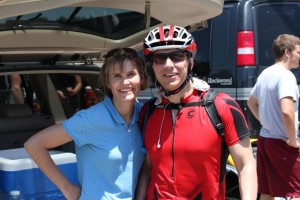
    Rest stop @ 110 miles with my supporting angel

    After a few miles, my good friend Todd circled back to pull me in for the final 10 miles. Zach and Bill joined up after fixing two flats and we picked up one more stray rider. The five of us rolled across the finish line on the west coast at 5:31 pm with nearly three hours to spare before sunset. Stopping felt great. So did the dip in the lagoon.

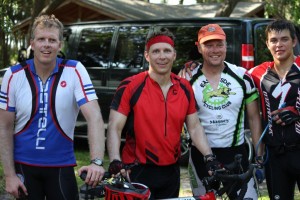
    Done. Todd, me, Bill and Zach. Scratch that one off the bucket list.

    Thanks are due to my Creator, Ann, Todd, Zach, Bill, the Eastside Cycling Club and the Spacecoast Freewheelers. I couldn’t have made it without your help.