Tag: social media

  • The Inevitability of Shared Leadership

    In today’s new rules of work, getting meaningful work done is no longer place-centric or position-centric, but people-centric.

    The use of social media, not just for play, but as a primary platform for work-related interaction, has accelerated the shift from top-down hierarchies to flatter networks. Every organization has informal networks — back channels  — that allow people to get what they need, when they need it. Mobile devices and social media have turned these obscure jungle trails into relational super highways.

    This shift affects how you, as a leader, must perceive your role as an influencer.
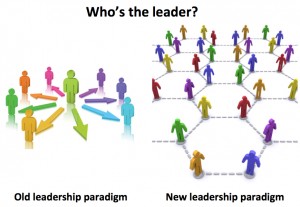
    Old and New Lship Paradigm

    Leadership is influence. Most of us were trained in a more traditional leadership model emphasizing the leader’s role as direction setter, change agent, spokesperson, problem-solver, strategy-formulator, vision caster, and aligner. Taken at face value, the net result of these roles and responsibilities will produce a leadership bench full of one-way communicators who are always selling and not necessarily listening.

    In the new leadership paradigm, each of us operates as a node in a network. We consume information, advice, counsel, and make decisions based on multiple interactions with other people, not just our boss. Who’s the leader? The one who can offer relevant help, initiate needed change, and model the way ahead. Shared leadership becomes organic in this environment; it is inevitable.

    Think about this from your own point of view. Where do you go for advice? I find myself searching Google, Twitter, or asking friends far more than I text or ring my boss.

    One implication for me as a team leader is that I must be clearer than ever with my team about who our primary audience is and what our desired outcomes are. When our mission is clear, informal networks strengthen our ability to get the work done rather than threaten my authority as a team leader. It’s time to embrace the inevitability of shared leadership.

    How are you experiencing the inevitability of shared leadership?
     

  • Why Leaders Use Social Media

    Leaders speak.

    It’s our job. We use words …

    • to create and express a compelling vision of the future
    • to inspire and encourage people around us
    • to speak God’s Word to various audiences
    • to engage others with questions and observations
    • to “write the vision and make it plain … so that he may run who reads it” (Habakkuk 2:2)
    • to empathize, respond and express love
    • in countless other ways to move people on to God’s agenda
    Leaders in the 21st century use social media to convey those words. I’ve just returned from the fantastic MinistryNet 2011 conference in Bangkok, Thailand. Last week 170 people from 32 countries gathered to discuss how to more rapidly advance the church’s mission of making disciples through the use of social media and digital technologies.
    .
    Key Insights
    1. The gospel has always spread most rapidly through existing social networks. In my opening keynote, I highlighted Paul’s ministry to the church at Rome. He names 27 friends in chapter 16 who were influential members of the Roman church — yet Paul had never visited Rome! He was exerting influence through key relationships in his social networks to help make his message stick. These networks included families (Acts 16), friends and acquaintances (Acts 16 & John 4:28-30), religious groups (Acts 17) and the marketplace (Acts 17). Today almost everyone has significant relationships in at least three of these networks.
    .
    2. Missions has always been about going to where people are and meeting them on their turf — that means we must be present online. Over half of the 800 million Facebook users log in to check their accounts daily. The average user has 130 friends. If you say you don’t have time to engage in social media it’s probably because you don’t understand it. It’s not just about letting people know what you had for breakfast (no one cares, btw). It’s about sharing, listening, speaking, learning and influencing others. We must humble ourselves and learn the tools of the new trade or be left way behind.
    .
    3. We must become good stewards of this communication avenue for good purposes and for good news. Here are some great resources from participants at MinistryNet and their friends on how to jump into social media:
       Brian Barela’s blog – Social Media Strategy for Ministries – @brianbarela
       Toni Birdsong’s blog – @StickyJesus – an equipping hub for online outreach – @tonibirdsong
       Brian Russell of LifeChurch.tv – resources here
       Steve Raquel’s blog – Lots of How To posts on using social media more effectively
    .
    What are you waiting for? You already have social networks. What’s keeping you from using them for good and for God?
  • How Social Networking Is Changing Our World

    It’s no longer a question of if? or when? The question now is to what extent? Whether you like texting, Facebook, YouTube or Twitter doesn’t really matter anymore. Social networking is changing our world. The recent uprising by young voters in Iran (nearly 2/3 of the country’s 71 million people are under 30) has instructed the old guard on the power of instant connection and the illusion of controlled information.

    Leading well involves actively listening to what people are talking about. Where are people talking? The use of the internet for social networking ranks in the top five media revolutions in the past 500 years (along with moveable type, the telegraph/telephone, recorded sound and moving pictures, and harnessing the electromagnetic spectrum to broadcast media), says TED presenter Clay Shirky. Shirky states:

    These tools don’t get socially interesting until they get technologically boring. It isn’t when the shiny new tools show up that their uses start permeating society. It’s when everybody is able to take them for granted.

    Watch this compelling and informative 17 minute video to see why this matters to you and your team. Show it at your next staff meeting and ask: How should this affect the ways we serve our clientele?