Year: 2013

  • Eating Digital Meat

    Read through the Bible, cover to cover, at least once every two years. That was some of the best advice I received from a mentor during my first year of ministry. This week I hit the halfway mark on my 14th pass through the Bible, and I’m enjoying a fresh twist.

    This year I committed to eat 100% digital meat.

    Eat This Book!

    The prophet Ezekiel began his ministry after receiving a rather odd instruction from God, “Eat this book. Then go and speak to the family of Israel.” God even encouraged Zeke to “make a full meal of it!” Afterward came the report: So I ate it. It tasted good — just like honey. (Ezekiel 3:1-3, The Message)

    You’ve probably heard the saying “eat your own dog food,” an exhortation for people in sales and marketing to use their own product before inflicting it on others. As VP of Digital Strategies for a mission organization, I felt led to eat 100% digital meat for all of 2013. Would I like it? How would it affect my personal devotional life? Would my passion for God and his ways increase? Or would I yield to the inevitable distractions inherent to digital devices?

    Print vs. Digital: Two Main Differences
    photo

    1. Daily Diet

    My motto for years has been “drink deeply daily” from Christ and his word. That hasn’t changed. What has changed is the media I’m using. Typically I would rise about 5 a.m., lay out a study Bible on the dining room table, open my journal, and dig in. I enjoyed making notes with a pen in the text and jotting thoughts, talk ideas, or personal applications in my journal.

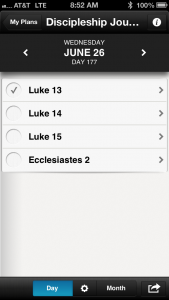
    In digital format, I have more ways to intake the Scriptures. First, the YouVersion app has made the daily part much easier to track (see screenshot). YouVersion Bible offers, as of today, 551 versions of the Bible in 322 languages, so you can pick your favorite flavor. Many versions also have an audible option that allows you to simply click and have the text read aloud. Amazing!

    Having the app installed on both my iphone and ipad allows syncing, so if I read in one place one day I simply pick up the next day on whatever device is handy. It’s mobile. This is fantastic for my frequent travels. The reading pane is uncluttered: no links, no notes, no graphics, no cross references, no bells or whistles, no ads, nothing. Just the meat.

    The app offers multiple reading plans. Ann and I are both using the Discipleship Journal reading plan. This plan requires you to eat three to four chapters each day. We like that it alternates between an OT book and an NT book, and includes a daily psalm or proverb. Both of us tired of reading plans that didn’t get into the NT until October.

    For deeper study and talk preparation I use Laridian’s excellent PocketBible app on both devices. This has commentaries, Hebrew and Greek tools, and multiple Bible versions. It also allows for quick cutting and pasting into Evernote, where I capture ideas for messages. For deep dives into the word and a much more extensive library of tools, I use Logos 4, mainly on my Mac. The point isn’t the tools, it’s the meat.

    2. Digestion

    The most important question is, How does this affect my walk with Jesus? I have discovered that my time with the Lord has, for the most part, been greatly enriched through using digital tools. I take my ipad out in the predawn darkness, read a psalm, and praise the God who made the heavens while looking up at the stars. Yesterday while driving to work I listened to four chapters of the book of Luke instead of DJs jabbering on the radio.

    I’ve enjoyed going audible, especially on the longer narrative passages from the OT. Listening to God’s word spoken has changed me. This is how the majority of the church before Gutenberg heard from God. It strikes the brain and heart differently. There have been several times while listening to the stories of the Bible that I’ve shouted out Wow! or That’s Amazing! Try to imagine you’re listening to the story of David and Goliath as a live newscast; you’ll see what I mean.

    It tastes good.

    What’s your favorite way to eat digital meat?

  • 4 Cultural Shifts Affecting You Now

    Recently a friend asked me this question: What are 3-5 forces or key variables that will affect the growth of our ministry?

    After pondering his question for several days, I responded with these four cultural shifts that are affecting you and me right now.

    1. Cultural shifts that reflect an underlying and often inexplicit post-modern worldview. Specifically, this generation has grown up believing that God is irrelevant, vulgarity is cool, and I am the center of things. When “I” am at the center my world lacks gravitas. It becomes increasingly more difficult to acknowledge that I am subject to norms of society or sources of authority outside of myself. This has serious implications for followership in a company, a marriage, a friendship, or in a discipleship relationship to Jesus.

    2. Urbanization and globalization. The world is smaller, but I am more isolated and overwhelmed as a result. This breeds a growing sense of anxiety and lack of permanence, which can be fueled by…
    _
    3. Digital technologies that promote addictive behavior resulting in information overload. Continual alerts (texts, emails, tweets) and the gamification of apps with badge notifications stimulate the same pleasure center in the brain as sex and addictive drugs. This results in a love/hate relationship with our devices and creates unrealistic expectations for other sources of less-exciting input (e.g. reading, studying Scripture, listening to a 30-minute sermon with intent to follow the logic of the preacher) that cannot be easily met. We struggle with sustained concentration. This results in a shallowness. We are cultivating a generation of tech savvy people who do not possess wisdom to live life rightly.
    _
    4. The deep heartfelt desire for meaningful relationships that bring purpose, connection and groundedness in light of #’s 1-3 above. We have answers for this. That is good news!
    _
    What cultural trend would you add to this list?
  • First, Change the Paradigms

    If things didn’t need to change we wouldn’t need you to lead.

    We could get by with some excellent management of existing resources. We could keep producing what we produced last year. We could point people to last week’s message (or book, or meeting, or event) and talk about how well things went. All of these are necessary, but none of them will help you and your tribe grow and continue bearing fruit through the next seasons of challenge and opportunity.

    One of the lessons I have learned during my seven year stint as a vice president for a 60-year old global nonprofit is this: to lead change, first change the paradigms. A paradigm is simply a mindset, a model, a template or an assumed way to look at things. In our case, I realized that in leadership gatherings, the ministry leaders I interacted with tended to emphasize two primary measures of success: (a) how many staff members they had working in their countries and (b) how many students were regularly attending their meetings. Both of those numbers indicate a degree of health and momentum. The paradigms were based on staff numbers and attendance.

    But our calling as an organization is to help fulfill the Great Commission which we do by making disciples among all tribes, tongues, peoples and nations. When we are at our best we raise and release leaders. So first we had to change the paradigms from staff-focused efforts to student-led efforts. Also, rather than allowing leaders to spend 90% of their time and emotional energy dealing with a handful of staff members on a few campuses, we asked them to dream about how they might reach out to students on the next 5, or 10, or 100 top tier campuses in their nation.

    This type of thinking took a few years to drive into the culture. It can’t be done in one leadership meeting or a single email blast. It required sustained focus through multiple conversations. We had to answer objections such as “we don’t have enough money, or staff, or time or whatever to think about adding more work to our schedule.” We helped people prune programs and events that were no longer necessary. We quit publishing and warehousing outdated materials. We highlighted early adopters who had voiced similar objections but had made the switch and were now experiencing the benefits of the change. We tried, in a friendly way, to starve ineffectiveness. In short, we changed the scorecard for effectiveness.

    The results? We’re praising God for a 39% increase in one year in the number of campuses we touch around the world, as well as a corresponding 33% increase in the student leaders involved with us. Most of the growth has not come from an increase in staff members, or from gathering more people into our meetings. It’s come from inspiring and releasing students to lead.

    If things didn’t need to change we wouldn’t need you to lead. What paradigm(s) do you need to change?